Wednesday, February 4, 2026

many forks, many roads: re: art and theory re: practice re: historical materialism

reading e-flux recently, and seeing the concern on art and theory, "art and theory: what relationship" by Emiliano Battista offers an intriguing, if not provocative, provocation on the lack of any substantial efforts to understand why artists (and curators) deploy theory in their practices. Battista not really arguing but maybe citing Ranceire's own skepticism in his continued relevance and citation on art practices. It is really an interesting and intriguing text. 

last semester, I taught art theory I [Plato to Marx]. this semester, I am teaching art theory II [anything and everything]. in the meantime, I have been teaching art history classes namely western, Asian, and philippine. Battista provocation got me thinking of what exactly is this relationship between art and theory is. as per Battista, their focus was on contemporary practices. but I think what might help in understanding this question is a historical approach. when did artists start using theory? what is theory? why art and theory?

photo taken: oct 18, 2025. kampuhan at the department of agrarian reform. pictured is the end of the shelters closest to the entrance gate of dar

I. 

I began my art theory I by asking what is theory and what is art theory. the question of art theory is more historical as it deals with the formation of "aesthetics" as a philosophical inquiry first posed by Kant. what is theory is a bit more challenging. why are art students [required for studio and theory majors] taking something called art theory? I pair Mao's "on practice" with Horkheimer's "traditional and critical theory." first fork. 

I pair these two texts as they have similar inquiries on theory but equally different approaches. Horkheimer, being part of Frankfurt school, approached theory by contrasting critical [marxist] theory which requires active participation and deployment of theory through practice with traditional theory that merely stores up knowledge informed by bourgeois intelligentsia [see: 11th thesis of theses on feuerbach]. on the other hand, Mao started with practice as means to derive theory. it is only in practice where a person or people can begin to form a theoretical perspective; starting from merely noticing, doing something about, seeing what happens, and finally deriving theory (interestingly Hegelian). what to do with this theory is elaborated on more on "on contradictions."

both texts were written in 1937. both were looking at their respective forks in their respective roads. Horkheimer was writing against the rising power of the Nazis while Mao was challenging dogmatism in china. but what is relevant to this blog post is their starting points. one starts from theory to practice and another is practice to theory. the correct answer is that theory and practice have a dialectical relationship where one should inform the other (a more correct answer is practice is primary). 

practice, however, takes on many forms. what is relevant to this post again is artistic practice. let's see what fork lies ahead with artistic practice, before we re-examine theory. 

II. 

I begin my art theory II by reading "when was modernism" by Raymond Williams. Williams posited a more historical approach to the question of modernism and its afterlives, i.e. post-. for Williams, "modernism" labelled as a movement was a retrospective act which aimed to depoliticize artistic political projects of artists from the turn of the century and allowed for commercial cinema, international commerce, advertising to coo-opt artistic innovations and provocations of these artists; the montage, the exile/internationale, the collage. 

what is crucial to this post is the (second) fork when artists began using political language as means to provoke and extend their practices. Williams argued that these artists, competing with mechanical reproduction, had to promote themselves. these artists, being exiles or nomads in pre-ww1 europe, came across political exiles of 1848. this, for Williams, resulted in the artistic manifesto. promoting their practices against each other while stating their political views is an interesting convergence of forks and perhaps the answer to Battista's question. artists mobilizing political language is the product of modernism. we can even go further, as with Williams, by citing the romantics of painting like Eugene Delacroix or the forebears of realism like Gustave Courbet. 

but we need to be one level deeper. when did political language become theory? it would be a leap to not ask this question; and it is a leap we need. Battista notes theory and not political language. enter scientific socialism. 

undefined

a well-worn example from Eugene Delacroix. "Lady Liberty Leading the People" (1830). note the idealism of "lady liberty" and the two figures on the left; the left-most depicts a man in disheveled clothing with his sword and tucked gun while to his right is a well-dressed man with a hunting rifle.

III. 

perhaps the major (third) fork in the road is between scientific and utopian socialism. in "socialism: utopian and scientific," Engels wrote about earlier (and some contemporary, regressive) forms of socialism that is utopian in contrast to what he proposed as scientific socialism. 

utopian socialism formed at around the turn of the 19th century following the French Revolution(s). for these utopian socialist, Engels argued, historical social ills were to be solved by reason. Emerging from the great conflict with the bourgeoisie against remnants of feudalism, and the subsequent betrayal of the bourgeoisie against their proletarian counterparts, these socialists, namely Saint-Simon, Fournier, and Owen (the first two are French while Owen is welsh), saw the brewing contradictions of the emerging bourgeois class and criticized them so. For Engels, the thinking of these men, while critical and important, were limited as the historical task of socialism was the task of reason, truth, and justice. 

Engels proposed a materialist dialectics which took from hegel a world of constant change and motion with the knowledge of natural science, of evolutions and transformations. citing marx as the discoverer of  a materialist history, Engels worked out how exactly did the modes of production affected and effected social change. Through historical materialism, the historical task of socialism was the historical task of the proletariat, not of idealist conceptions of reason, truth, and justice. If the bourgeoisie was able to revolt against feudalism, so too will the proletariat against the bourgeoisie. It is this materialist dialectics which enables a scientific understanding of socialism. 

So what does this have to do with art and theory? In the vaguest sense, it is the relationship between theory and practice. As noted earlier through Mao and Horkheimer, socialism is not merely a task for reason but a practical activity which enables a scientific socialism. It is this practical activity which, thinking through Williams, modernist artists attempted to confront; theorizing their practices and practicing their theories. 

IV. 

aside from teaching art theory and art history, I was intrigued by Battista's provocation as it problematizes crucially why artists (and curators) use theory that is not necessarily concerned with aesthetics. as they noted, what has Hirschhorn got to do with Spinoza, Deleuze, and Gramsci? we can note contemporary cultural theorists like mark fisher in noting "capital realism" and the aesthetics of contemporary politics. but Williams' arguments on modernism might be closer to what Battista is looking for. 
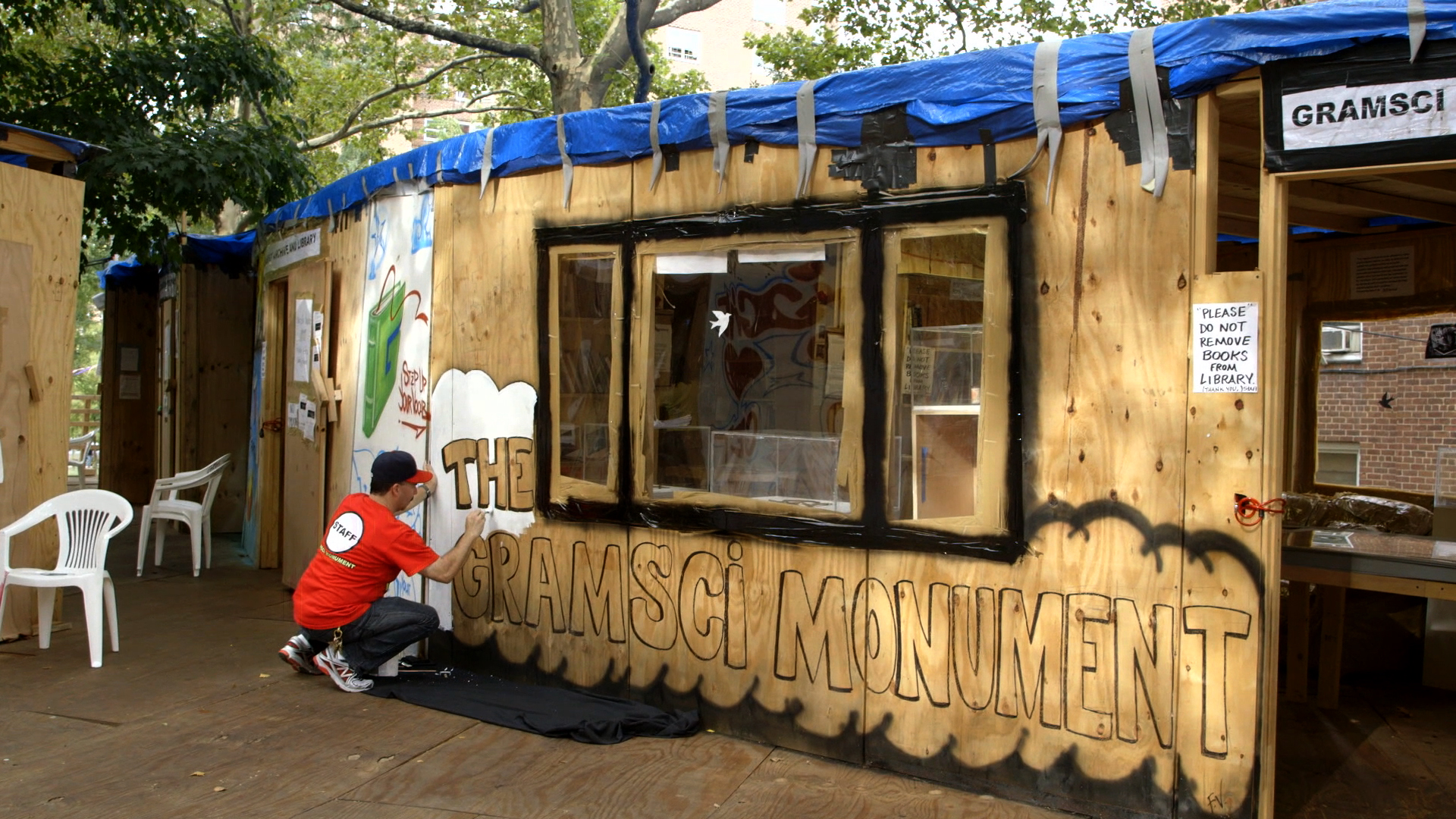
 "Gramsci Monument" by Thomas Hirschhorn (2013), Bronx, New York

Figure 5 - from Artificial Hells: Participatory Art and the

 "Bataille Monument" by Thomas Hirschhorn (2002), documenta

V.

as a detour, ive been meaning to write something about the exhibitionary value of the kampuhan. the last one, as of writing this, was in front of the department of agrarian reform. the kampuhan is set up by farmers from around the philippines and peasant advocates (among others) to occupy the outside premises of dar and insist on their right for their land.

what this petty b teacher is interested in is the form which it takes. the structure for the kampuhan needs to provide shelter for the farmers and activists who will be sleeping through the night while also being a site for educational discussions in the morning and afternoon with the inclusion of cultural performances in the evening. with these requirements, the last kampuhan was a series of triangular shelters, all connected, made up of tarpaulin roofs and a long piece of wood from which the tarps would drape. you can walk from one end of the kampuhan to the other with various zones dedicated to educational discussions, mural painting, medic zone, rehearsal space for cultural performances, and general sleeping quarters. 

photo taken: mar 25, 2025. the side of the kampuhan facing the qc circle. 

photo taken: mar 25, 2025. chords and lyrics for tano at the rehearsal zone of the kampuhan

photo taken: mar 25, 2025. banners on a former jeepney stop next to the kampuhan

outside the triangular structure, placards and calls for genuine land reform serve as a wall against the harsh afternoon heat as well as for passers by to understand or at least note what is happening. the other wall, of course, is the gate of dar. 

why I am noting the kampuhan is it reminds me of the monuments of Hirschhorn dedicated to theorists. these monuments were noted in Battista's text. rather than noting theorists, however, the kampuhan is the product of various peasant struggles in the philippines unified by their call for genuine agrarian reform. rather than a simulation of cardboard shacks of Hirschhorn's monuments, the kampuhan addresses urgent needs of the farmers who travelled far and risked their lives to demand their land at the doorstep of dar. while Claire Bishop might note the antagonism between hirschhorn's monuments and the biennials he participates in, the kampuhan calls for solidarity across farmers, workers, students, general passers by, and highlights the antagonism of the state against the farmers of the philippines. 

what I want to point out by pointing out the kampuhan is how it teases out practice and theory. the countless hours spent by organizers and farmers in organizing the kampuhan and the safety of its participants is where new theory is made. rather than signifying a theory, as noted by Battista from artistic practices, theory finds form in material needs through practice. it is not a "theoretical practice" as its theory will be tested by police presence, intelligence units, and state harassment. as Mao noted elsewhere, correct ideas come from social practice. 

VI.

perhaps what is also underlined here is so-called failure of the "avant garde" in uniting art and life, and inevitably politics. interestingly,  the first use of "avant garde," a French military term, in reference to artists is attributed to saint-simon. the mission of the modernists to question the boundaries of art is a question we keep asking in my classes. how do we make better, newer art? or perhaps, better put, as Mao asked elsewhere, for whom? 

what I am trying to get at, I think, is a reframing of "failure" as a momentary defeat in a well-worn battle. I was recently forwarded this text by Cem A alias freeze magazine called "consensus aesthetics: the political economy of agreement in contemporary art." maybe what bourgeois art mines in dusty theory is what revolutionary art (or broadly aesthetics) seeks to write in practice, if that makes sense. 

Friday, April 2, 2021

recent thoughts on decolonization

 i recently finished asia as method and half-finished wretched of the earth. both are really good in assessing decolonization and, in the case of asia as method, deimperialization. but i think both lacked or forgot the importance of the writings of mao zedong in decolonial methods. 


for wretched of the earth and mao you can read more about it here.

what i wanna talk abt is the ideas of nationalism brought up in asia as method and mao's idea of contradictions. chen kuan-hsing identifies different attempts for nationalism in newly formed nation states. currently, i cannot be bothered to look them up but as far as i remember they were traditionalism and nativism, and something else. i bring them up as it is important to understand why they are failures for nationalism and I think mao's "contradictions" will offer us better insight into their failures. 

contradictions, to mao, are things that exist in a dialectic with one another that it becomes the identity of that thing. going with the notion of decolonization, an example would be the contradiction between the philippines and united states. the relationship between the philippines and america is part of the philippines identity even though they exist in opposition to the desire of independence hence a contradiction. (important to take note that contradictions, while integral to the identity of a thing, should be seen as temporary as all contradiction needs to be resolved and resolving these contradictions is what moves history and movements)

and for a given thing, there could exist many contradictions (which is important in decolonization). still using the philippines as an example, there is a contradiction between the philippines and imperialist nations (such as america and china), within the philippines, there is a contradiction between feudal landlords and the peasants, there is also a contradiction between genders. contradictions can define an identity as they compound and complicated relations.


chen briefly talks about how identity politics like feminism and race relations is often seen as isolated from capitalism, colonialism, and imperialism even though they only exist in one system. here, i think is where chen could've used mao's contradictions in order to unpack that problem. 

through assuming contradictions as part of one's identity, identity politics could be unpacked and connected to bigger notions of capitalism, colonialism, and imperialism. fanon touches on this when he says that colonized men desire white women in order to perform and become a white man. in short, colonialism changes desires and affects gender relations (many studies on this). A contradiction (contradiction between colonized and colonizer) creates another contradiction (contradiction between colonized male bodies and colonized female bodies) therefore creating an identity comprised of compounding contradictions. 

Going back to the chen's examinations of several attempts for nationalism, traditionalism and nativism, we can also unpack through their contradictions and why they don't work as nationalist portrayals. ideas and ideals of going back to an origin and creating a distilled notion of a people, like focusing of native (maybe we can use the word indigenous??) identities or traditional (sometimes, tradition includes colonization, esp in the ph, as christian traditions) identities, remove/ignore the layers of contradictions that are present. ignoring contradictions fails to grasp the material history of colonized lands and peoples. and failure to understand and handle contradictions will only lead to internal disputes and uncertainties as mao puts it. 

anyway, i think people should really quote mao more when talking about decolonization as one of the first and still leading thinkers of dealing with decolonization.


Tuesday, March 16, 2021

on 90s music

 below is an email i sent to 8minutecapecod@gmail.com when they discussed 90s music and why they seem so self-deprecating on time crisis

Hi crisis crew!

I was re-listening to episode 129: Green day and yellow mustard, and Ezra asked why in the 90s there was a wave of self-deprecating songs (Basketcase, Creep, Loser, Nirvana discography) unlike the eras before and after which has more songs with angst redirected outwardly. 

This tangent reminded me of Capitalist Realism by the late Mark Fisher. Published in 2009, the book mostly talks about the post-cold war, post-berlin wall state of the world, which is also the era of said self-deprecating songs. 

A section in that book talks about mental health in a capitalist society where it's privatized and mostly directed inwards. In a capitalist society in which mental health is not politicized, issues are mostly dealt with therapy and medication. Erza pointed out that Satisfaction by Rolling Stones is angry but external and I think it is mostly because in the 60s and 70s they had thinkers like Lacan, Deleuze, and Guattari who wanted to tackle mental health from a political standpoint—externalizing the factors of mental health and relating it to a political landscape. 

With the fall of the Berlin Wall (1989) and the collapse of the Soviet Union(1991-2), capitalism and its ideology of individualism  ""succeeded"" over socialism. The privation and privatization of mental health became the mainstream way of approaching it which could be seen in Basketcase (1994).

Monday, February 15, 2021

bands as projects as bands

i just finish listening to "stay free" a podcast on spotify abt the clash and i feel so inspired and focused. on the last episode (spoiler alert) when joe strummer fired mick jones and justified the clash continuing as smth bigger than them and will continue to do clash things, it got me thinking. 

another way of putting what joe strummer said is that the clash is a project and it always has been since d beginning. always focused on talking abt socialism and internationalism, the clash was more than the music and music was merely an aspect of trying to achieve smth (to change the world as they would say). 

thinking more abt projects now, projects should involve methodologies and hypotheses than a blind pursuit. Regardless if its too hyperfocused or overdetermined [invalid critique], it should be seen as an attempt to re-examine and contextualize practices. Only when it has achieved its hypothesis or realized its methodologies failures can it change, but why not break-up? 


[[last-gig by joe strummer w mick jones for a benefit concert for firefighers on strike: https://www.youtube.com/watch?v=hu-02udB57w]]


Wednesday, January 15, 2020

american media and bong joon ho's parasite

parasite (2019) is a great film, no doubt. but what's really interesting to me the reception it's getting from the land of milk and money.


in his seminal book "capitalist realism", mark fisher talks about wall-e and how it (and films like wall-e) perform anti-capitalism for us as to pacify its viewers. In order for us not to revolt against capitalism (with its effects like global environmental destruction with wall-e), entertainment corporations much like disney make films that are seemingly critical of capital only to resolve with the same relationship with capital as before.

of course, or at least i hope and it seems like this is true, bong joon ho has different intentions compared to disney. aside from not having a monopoly on entertainment and partnering with the military for script supervision, bong joon ho tackles capitalism in his other films and in his interviews. but just because bong joon ho is not disney doesn't mean that his film would be received as something disney-like especially by media and celebrities from the world's most powerful nation. it's weird how architectural digest talks about the set design of a film rich of visual gestures to inequality.

what i would like to add to mark fisher's performative anti-capitalism is performative anti-american imperialism.

parasite is getting a lot of buzz espcially with american brainwashing awards. with this buzz, bong joon ho acts nonchalantly as he knows that these awards are mainly about america celebrating america rather than celebrating cinema. but with the american accolades (if you can call them accolades), america recognizes an external critique of its capitalist machine.

“This film is about the rich and poor and about capitalism — and the U.S. is the heart of capitalism. I thought it was a natural response.”

parasite being engulfed in american awards fiasco is devaluing its critique of capitalism and its heartland. by embracing a director who is critical not only of capitalism but also of america, hollywood wants us to know that it knows problems of america and how america propagates capitalism but it would also allow the joker in the same category.

short review of the joker: i think it's all american propaganda with the silly pent-up anger of the working class. the movie depicts the working class as sympathetic to a lunatic murderer who is tangential to gotham's inequality. at the end of the movie, riots rage as the joker killed de niro and the working class heralding him as the instigator of a class war that is unorganized and chaotic for the sake of chaos. therefore,  i conclude, that the joker depicts the demands of the working class with the inequality of gotham as something silly because they see a crazy guy as a hero and they merely want nothing but violence and chaos.

anyway, by putting the joker and parasite together in the same category, hollywood juxtaposes these two movies as something of equal footing therefore devaluing critiques from parasite and bong joon ho. with a movie like parasite and a director like bong joon ho, they depict the world with people who are victims of capitalism and by putting it next to the joker....... respeto naman guys

i would like to thank the CIA for nominating parasite and bong joon ho.


Monday, January 13, 2020

revisiting late 90s early 00s romcoms re:capital

lately ive been interested in watching romcoms from da turn of the century. it comes to no surprise that there r lapses in politcally correct humor but what is surprising to me is the acceptance of capitalism and neoliberalism in this era of romcoms (in contrast to now with every other movie being woke whether necesarilly or not [slowly sounding like a boomer incel]).

take two weeks notice and youve got mail. two classics of the era.


two weeks notice, brought to u by hugh grants and america's sweetheart sandra bullock, is about a real estate tycoon (picture a donald trump) and a harvard gradute idealistic environmental lawyer. to someone who has had their politcal awakening in the late 2010s, the premise is wild and unimaginable. picture an AOC type politician getting together with an elon musk type venture capitalist for a romcom. what a diff world the turn of the century was.


and then the classic youve got mail. tom hanks owns a multimillion (fascinating how its just multimillion compared to the now billion) bookstore chain and he seeks to destroy a small, humble kids bookstore around da corner owned by meg ryan. classic new york story. gentrification, big corpo next so smal business, classic nyc. tom hanks was just annoying in dis movie. n meg ryan is just so charming and smart and has short hair. im also fascianted with roger eberts review of this movie "Say what you will, those giant stores are fun to spend time in"

i rewatched spiderman far from home earlier. i enjoyed it but it also really annoyed as american propaganda. i think marvel movies would be the next cultural artifact that the future generation would find weird, hopefully anyway.

Saturday, April 5, 2014

COLOR? color.

In which artist Tom Sachs shows us the colors they use in his studio.